> For the complete documentation index, see [llms.txt](https://docs.assenteo.com/llms.txt). Markdown versions of documentation pages are available by appending `.md` to page URLs; this page is available as [Markdown](https://docs.assenteo.com/guides/what-is-the-responsible-artificial-intelligence-1.md).
# Privacy by Design strategies: Zero-party data
It is one of the hottest buzzwords in marketing right now. Zero-party data. And it’s all about asking instead of inferring.
Customers are becoming increasingly wary of how their data is being collected and used. And legislation like the General Data Protection Regulation (GDPR) are starting to be more strictly enforced. [A recent lawsuit was brought against Oracle and Salesforce](https://tcrn.ch/30VOg8l) for their use of third-party tracking cookies, which if successful could end up with fines in excess of €10BN.
At the same time, customers demand a more personalized experience, with 66% of shoppers saying [a poorly personalized experience would stop them from purchasing](https://cmo.adobe.com/articles/2018/1/adobe-2018-consumer-content-survey.html#gs.deb7am).
**What is Zero-Party Data?**
Zero-party data is information that customers voluntarily share with a company. Unlike data tracked and inferred from user behavior, it is explicitly provided by the customer often in exchange for a more personalized and improved shopping experience.
Zero-party data is collected through questions such as:
* “How often do you want to receive emails from us?”
* “What type of content do you like to watch?”
* “How was your most recent experience in our store?”
The answers to questions like these are all **zero-party data**, and brands can use that information to create better experiences for their customers.
Zero-party data differs from first, second and third party data types because it is **provided by the customer**, not inferred from their behavior. It’s information **a customer wants a company to know**. It doesn’t have the creepy, invasive nature that some other forms of data collection can have.
And it’s always given with full consent.
Zero-party data presents marketers with an opportunity to collect valuable, actionable, and ethically-gathered information about customers in a time where data collection and usage is fraught with challenges.
We’ll take a look at some of the ways brands can collect zero-party data, and then see some of the [use cases](https://www.bloomreach.com/en/library/use-cases) that can be implemented with it.
#### How to Collect Zero-Party Data
Since zero-party data is given freely by a customer in return for a more personalized experience, it doesn’t make sense to collect it for anonymous customers. Zero-party data only makes sense for **identified customers.**
This means the first place you can start to collect zero-party data, is during the new user registration process (or when they sign up to receive your newsletter).
**Zero-Party Data Collection Upon Registration**
The exact type of information you ask for at registration will depend on your particular business. Let’s see some examples for inspiration.
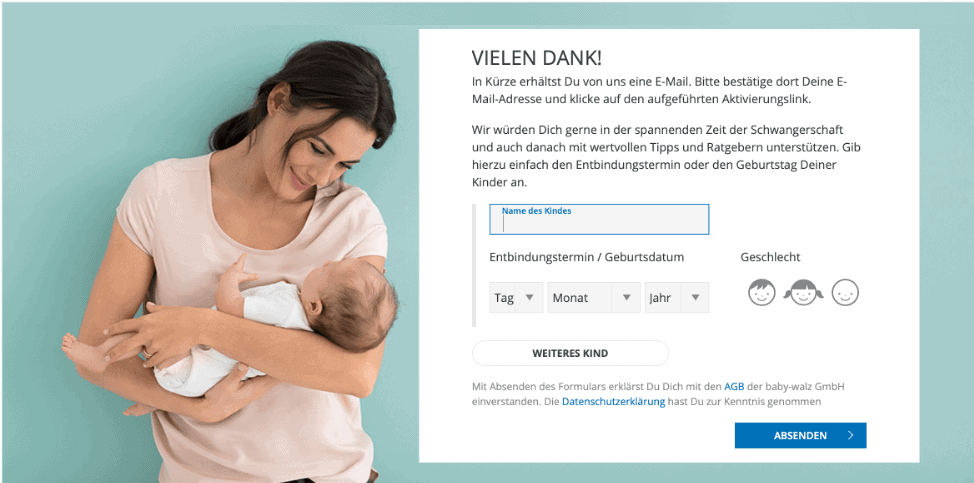
Bloomreach customer [baby-walz collects zero party data](https://www.bloomreach.com/en/case-studies/baby-walz-uses-bloomreach-engagement-to-deliver-incredible-customer-experiences) when users register for its mailing list. baby-walz specializes in products for expectant parents, infants, and young children. So when a user registers for its mailing list, the company asks for some information about the child.
 *Source:* [*baby-walz*](https://www.baby-walz.de/)
New customers are often happy to provide this information because they know they’ll get more relevant information from baby-walz. And baby-walz gets higher quality data that they can use to create improved customer experiences online.
Stores that sell pet food use a similar strategy, asking new subscribers to give a little bit of information about the pet they’re shopping for.
It’s important to **not overwhelm customers with questions** when they register their accounts. You need to maintain a careful balance between getting enough information to improve the customer experience and keeping the experience relatively friction-free.
Another important note: **only ask for data that you will actually use to improve the customer experience.** If you ask your customer about what type of pet they have, then send them totally irrelevant offers, **you’re going to annoy them.** You might even lose them as a customer. So only ask for what you can actually use.
**Collecting Zero-Party Data on Your Site**
Collecting zero-party data upon customer registration is an obvious choice, but it’s not the only one. Zero-party data can be collected during any interaction with customers, including while they’re on your site.
You can collect zero-party data from category pages. An example below shows how a clever choice of button copy can turn a simple “see more” button into an opportunity to collect zero-party data.
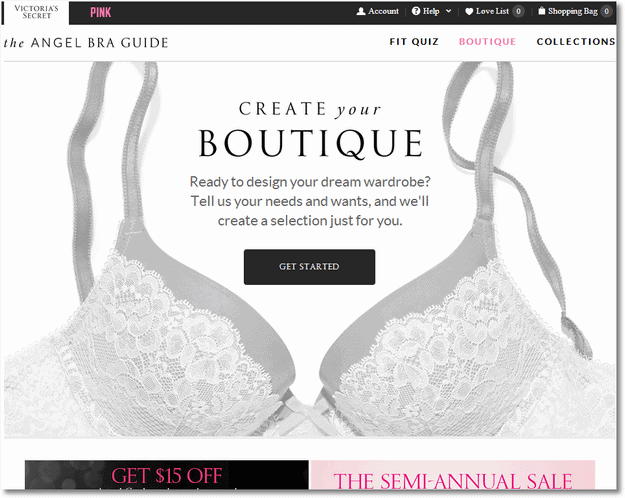
Some companies have even dedicated entire sections of their site into a zero-party data experience. Take a look at this example from Victoria’s Secret.
*Source:* [*baby-walz*](https://www.baby-walz.de/)
New customers are often happy to provide this information because they know they’ll get more relevant information from baby-walz. And baby-walz gets higher quality data that they can use to create improved customer experiences online.
Stores that sell pet food use a similar strategy, asking new subscribers to give a little bit of information about the pet they’re shopping for.
It’s important to **not overwhelm customers with questions** when they register their accounts. You need to maintain a careful balance between getting enough information to improve the customer experience and keeping the experience relatively friction-free.
Another important note: **only ask for data that you will actually use to improve the customer experience.** If you ask your customer about what type of pet they have, then send them totally irrelevant offers, **you’re going to annoy them.** You might even lose them as a customer. So only ask for what you can actually use.
**Collecting Zero-Party Data on Your Site**
Collecting zero-party data upon customer registration is an obvious choice, but it’s not the only one. Zero-party data can be collected during any interaction with customers, including while they’re on your site.
You can collect zero-party data from category pages. An example below shows how a clever choice of button copy can turn a simple “see more” button into an opportunity to collect zero-party data.
Some companies have even dedicated entire sections of their site into a zero-party data experience. Take a look at this example from Victoria’s Secret.
 *Source:* [*Victoria Secret*](https://www.victoriassecret.com/)
Customers are willing to share information because they’ll get a wardrobe that’s tailored to them. In return, Victoria’s Secret gets valuable zero-party data about its customers, which can be used to further improve its communications and customer experiences.
**Collecting Zero-Party Data from Social Media**
Another powerful way to collect zero-party data is by using social media. Polls, surveys, and engaging posts can all offer the opportunity for customers to share their preferences and intentions. This requires thoughtful execution, but the results can be great.
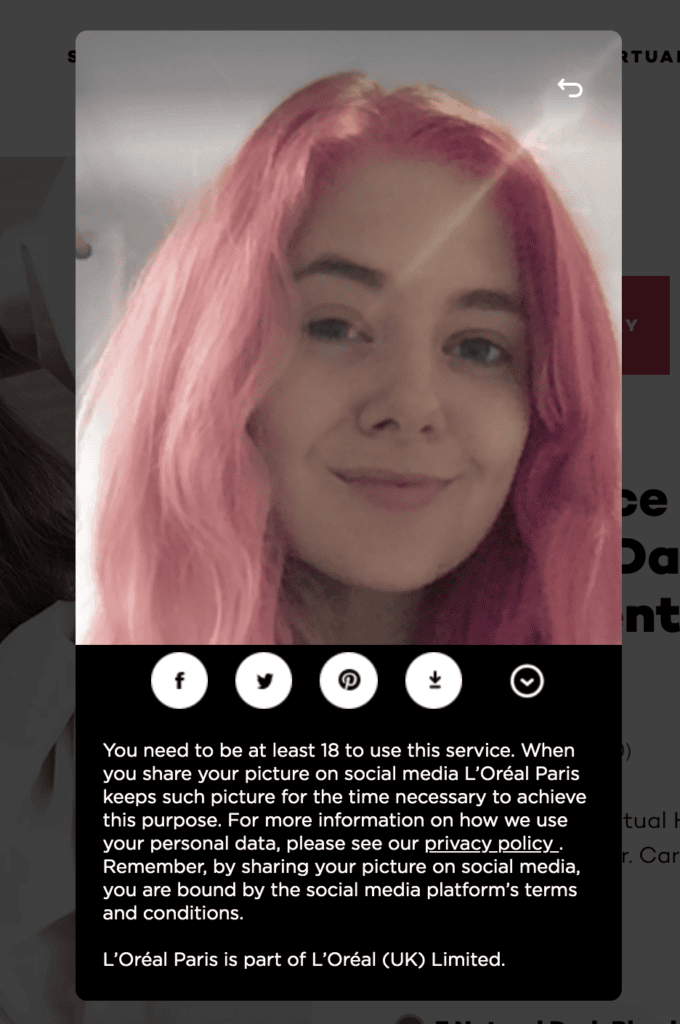
L’Oreal lets customers virtually try on their products via their camera, then lets users share their photos directly to their social accounts.
*Source:* [*Victoria Secret*](https://www.victoriassecret.com/)
Customers are willing to share information because they’ll get a wardrobe that’s tailored to them. In return, Victoria’s Secret gets valuable zero-party data about its customers, which can be used to further improve its communications and customer experiences.
**Collecting Zero-Party Data from Social Media**
Another powerful way to collect zero-party data is by using social media. Polls, surveys, and engaging posts can all offer the opportunity for customers to share their preferences and intentions. This requires thoughtful execution, but the results can be great.
L’Oreal lets customers virtually try on their products via their camera, then lets users share their photos directly to their social accounts.
 *Source:* [*L’Oréal*](https://www.loreal.com/en/)
In theory, such an application lets a brand like L’Oreal see what types of products specific customers are interested in, which can be used to improve their future communications. It also has the added benefit of creating social proof for L’Oreal when users share photos with their networks.
#### Collecting Zero-Party Data from Other Channels
In theory, zero-party data can be collected from any channel that a customer interacts with. We don’t have examples for every channel, since many brands are just starting to realize the value of zero-party data. But we can walk through some hypotheticals.
**Customer Service.** An interaction with customer service is a direct link to the customer, and provides a valuable opportunity to collect first-party data. The problem, however, is that CRM systems are often not connected with marketing systems. This means that whatever zero-party data you collect from a customer service call won’t be used to improve the customer experience.
**Email.** Most brands ask for feedback from a customer after they’ve had some interaction with them. This feedback can be considered zero-party data.
Again, if you have a [single customer view](https://www.bloomreach.com/en/blog/single-customer-view-scv-overview), you can use the zero-party data collected from email campaigns to improve the customer experience across all channels.
**In-store.** In-store and online experiences are starting to blend together, and most retailers want to find a way to connect the physical shopping experience with the virtual one.
It’s not uncommon to see tablets in stores, letting customers register an account, browse through a shop’s catalog, or even set up an appointment.
These can also offer a chance to collect zero-party data. Bloomreach client [Sofology](https://www.bloomreach.com/en/blog/sofology-and-bloomreach-a-one-year-retrospective-how-to-get-the-most-out-of-bloomreach), a popular furniture retailer in the United Kingdom, uses tablets in its store to help customers design their dream sofa. The information collected from an in-store visit is added to their customer profile and used to create more relevant messaging.
Watch this video below to see how Bloomreach makes it possible to connect online and offline interactions into one seamless shopping experience:
**Any Other Channel.** Again, wherever there’s customer interaction, there’s the chance to collect zero-party data. As long as you can connect it with a unified customer profile, you can use it to create impressive customer experiences.
#### Zero-Party Data Principles
One of the major differences between zero-party data and first, second, and third-party data is its focus on customer centricity, transparency, and respect for the wishes of the customer.
In the spirit of respecting those differences, we recommend a few principles for collecting and working with zero-party data.
**Triple Transparency.** GDPR requirements demand transparency when collecting data. But that transparency often takes the form of an incomprehensible cookie banner that’s displayed when you visit a site. Many of these banners are so unclear or hard to navigate that it’s impossible to tell if a customer has opted in to data tracking or not.
On the contrary, zero-party data collection should be **clear, transparent, and easy to understand** from the very beginning.
The principle of triple transparency means being clear when you’re:
* **Collecting data**
* **Utilizing zero-party data**
* **Letting customers change their data**
Maintaining this transparency helps ensure you’re using zero-party data in a customer-centric manner.
**Transparency When Collecting Data**
Thanks to legislation like the GDPR, many companies are already transparent about when they’re collecting data. Nevertheless, it’s important to maintain that transparency when you’re collecting zero-party data as well.
For example, when a customer is signing up for your newsletter and you’d like to ask them for some additional information, be sure to clearly tell them exactly what information you will keep, and how you want to use it.
If you want to be truly customer centric, then just linking to a privacy policy isn’t enough. You should be clear about the data you’re collecting directly where you’re collecting it.
This level of transparency helps generate trust in your business, and gives the customers an incentive to share their information with you.
**Transparency When Utilizing Data**
Being transparent about when you’re using zero-party data can help reinforce a customer’s decision to share that data with you. It doesn’t need to be anything excessive, a simple message is often enough.
**Letting Customers Change Their Data**
Preferences change. Tastes change. Interests and budgets change. All of these changes are reflected in what customers want and expect. It’s important to allow customers to alter the zero-party data that they share with you.
A customer might love your emails and want to receive more of them. Maybe they recently moved, and their preferences for furniture have changed. Or maybe they’ve discovered a favorite new brand, and want to see more from them on their homepage.
A company with a sophisticated zero-party data strategy will **let customers change their zero-party data.** This is often handled from a preference center, connected to their account with your business.
Amazon provides an excellent example of such a preference center, as shown below.
An excellent preference center will show the data that’s been collected so far, how that data is used, and will let the customers update their preferences directly.
####
#### Zero-Party Data Use Cases: From Simple to Advanced
You don’t need to jump straight into complex [use cases](https://www.bloomreach.com/en/library/use-cases) to start seeing value from zero-party data. You can start simple and build from there. The most basic use cases can most likely be accomplished with the tools you already have. More advanced use cases will require sophisticated technology, but the rewards for your business and your customers are worth it.
We’ll take a look at some sample use cases here.
**Simple: Product Discovery via Quiz**
**Requirements:** Developer capacity, creativity.
A quiz can be an easy way to collect zero-party data while also helping your customers to find the right products for them.
You could make a short personality quiz that recommends products based on your customers personality. That info could then later be used to personalize communications with your customers (provided you gathered it with the right consent).
These types of quizzes can work for all types of verticals. A bank could use a personality quiz to understand spending habits and then recommend the right type of credit card. A travel agency could use a quiz to recommend destinations. And a clothing company could use a quiz to recommend the right styles.
All you need to execute this use case is some developer skill and some creativity. But if you want to use the data you collect for future campaigns, you will need to store it in a single customer view.
[Bloomreach customer My Jewellery had incredible success](https://www.bloomreach.com/en/case-studies/myjewellery-gets-creative-with-zero-party-data-and-bloomreach-engagement) with this strategy. It created the [style profile test](https://www.my-jewellery.com/nl-nl/stijlprofiel-test) to collect zero-party data from customers. It increased email open rates by 20% because of the creative campaign.
**Intermediate: Personalized Newsletters**
**Requirements:** Zero-party data collection upon customer registration, email marketing tool.
The most simple way to start using zero-party data is to start personalizing your newsletters. Collect relevant information when customers subscribe to your mailing list. That could be things like their favorite brands, their gender, birthday, info about their pets…anything that’s pertinent to both them and your business.
Then, use the information you’ve collected to personalize your marketing emails. If you’re collecting only basic information (e.g. gender), you can then segment your mailing list and create different emails for each segment.
If the information you’re collecting is more varied (e.g. favorite brands), you can either use a recommendations engine to help create your email, or use another type of [personalization tool](https://www.bloomreach.com/en/products/engagement/web-personalization) to fill your emails with relevant information.
[BrewDog](https://www.bloomreach.com/en/case-studies/how-brewdog-increased-revenue-using-personalized-email-campaigns-with-bloomreach), a Bloomreach customer, used [personalized email campaigns](https://www.bloomreach.com/en/blog/email-personalization-your-guide-to-better-email-marketing-campaigns) to increase revenue from email 13.8% and conversion rate from emails 11.5%.
**Advanced: Personalized Homepage**
**Requirements:** [On-site personalization](https://www.bloomreach.com/en/blog/2019/07/digital-commerce-explained) capabilities, single customer view with zero party data.
A completely personalized homepage or storefront is perhaps the pinnacle of zero-party data usage. It means curating the page a user see when they visit your site, based on the information they’ve provided to you.
Accomplishing this means you need the ability to completely personalize your website based on the information you have about your customers. Tools like Bloomreach or other marketing automation tools make this possible.
A personalized homepage can significantly speed up product discovery and customer satisfaction, leading to increased average order values, reduced time between repeat purchases, and lower cart abandonment rates.
Jenson USA used [Bloomreach Discovery](https://www.bloomreach.com/en/products/discovery) and [Bloomreach Engagement](https://www.bloomreach.com/en/products/engagement) to increase revenue per visitor (RPV) 8.5% thanks to [optimizing search results based on customer segments.](https://www.bloomreach.com/en/case-studies/jenson-usa-sees-increased-rpv-with-bloomreach-engagement-and-discovery) The strategy also led to a 26% increase in RPV for segmented searchers on mobile devices.
---
# Agent Instructions
This documentation is published with GitBook. GitBook is the documentation platform designed so that both humans and AI agents can read, navigate, and reason over technical content effectively. Learn more at gitbook.com.
## Querying This Documentation
If you need additional information that is not directly available in this page, you can query the documentation by asking a question.
Perform an HTTP GET request on the following URL with the `ask` and `goal` query parameters:
```
GET https://docs.assenteo.com/guides/what-is-the-responsible-artificial-intelligence-1.md?ask=&goal=
```
`ask` is the immediate question: it should be specific, self-contained, and written in natural language.
`goal` is what the user is ultimately trying to achieve, the reason they need the answer. Sharing it helps GitBook give you a better, more relevant answer. A goal is most helpful when it describes the outcome the user wants rather than restating the question. For example, with `ask=how do I create an API token`, a goal like `automate deployments from our CI pipeline` lets GitBook tailor the answer to that use case.
The response will contain a direct answer to the question and relevant excerpts and sources from the documentation.
Use this mechanism when the answer is not explicitly present in the current page, you need clarification or additional context, or you want to retrieve related documentation sections.
*Source:* [*L’Oréal*](https://www.loreal.com/en/)
In theory, such an application lets a brand like L’Oreal see what types of products specific customers are interested in, which can be used to improve their future communications. It also has the added benefit of creating social proof for L’Oreal when users share photos with their networks.
#### Collecting Zero-Party Data from Other Channels
In theory, zero-party data can be collected from any channel that a customer interacts with. We don’t have examples for every channel, since many brands are just starting to realize the value of zero-party data. But we can walk through some hypotheticals.
**Customer Service.** An interaction with customer service is a direct link to the customer, and provides a valuable opportunity to collect first-party data. The problem, however, is that CRM systems are often not connected with marketing systems. This means that whatever zero-party data you collect from a customer service call won’t be used to improve the customer experience.
**Email.** Most brands ask for feedback from a customer after they’ve had some interaction with them. This feedback can be considered zero-party data.
Again, if you have a [single customer view](https://www.bloomreach.com/en/blog/single-customer-view-scv-overview), you can use the zero-party data collected from email campaigns to improve the customer experience across all channels.
**In-store.** In-store and online experiences are starting to blend together, and most retailers want to find a way to connect the physical shopping experience with the virtual one.
It’s not uncommon to see tablets in stores, letting customers register an account, browse through a shop’s catalog, or even set up an appointment.
These can also offer a chance to collect zero-party data. Bloomreach client [Sofology](https://www.bloomreach.com/en/blog/sofology-and-bloomreach-a-one-year-retrospective-how-to-get-the-most-out-of-bloomreach), a popular furniture retailer in the United Kingdom, uses tablets in its store to help customers design their dream sofa. The information collected from an in-store visit is added to their customer profile and used to create more relevant messaging.
Watch this video below to see how Bloomreach makes it possible to connect online and offline interactions into one seamless shopping experience:
**Any Other Channel.** Again, wherever there’s customer interaction, there’s the chance to collect zero-party data. As long as you can connect it with a unified customer profile, you can use it to create impressive customer experiences.
#### Zero-Party Data Principles
One of the major differences between zero-party data and first, second, and third-party data is its focus on customer centricity, transparency, and respect for the wishes of the customer.
In the spirit of respecting those differences, we recommend a few principles for collecting and working with zero-party data.
**Triple Transparency.** GDPR requirements demand transparency when collecting data. But that transparency often takes the form of an incomprehensible cookie banner that’s displayed when you visit a site. Many of these banners are so unclear or hard to navigate that it’s impossible to tell if a customer has opted in to data tracking or not.
On the contrary, zero-party data collection should be **clear, transparent, and easy to understand** from the very beginning.
The principle of triple transparency means being clear when you’re:
* **Collecting data**
* **Utilizing zero-party data**
* **Letting customers change their data**
Maintaining this transparency helps ensure you’re using zero-party data in a customer-centric manner.
**Transparency When Collecting Data**
Thanks to legislation like the GDPR, many companies are already transparent about when they’re collecting data. Nevertheless, it’s important to maintain that transparency when you’re collecting zero-party data as well.
For example, when a customer is signing up for your newsletter and you’d like to ask them for some additional information, be sure to clearly tell them exactly what information you will keep, and how you want to use it.
If you want to be truly customer centric, then just linking to a privacy policy isn’t enough. You should be clear about the data you’re collecting directly where you’re collecting it.
This level of transparency helps generate trust in your business, and gives the customers an incentive to share their information with you.
**Transparency When Utilizing Data**
Being transparent about when you’re using zero-party data can help reinforce a customer’s decision to share that data with you. It doesn’t need to be anything excessive, a simple message is often enough.
**Letting Customers Change Their Data**
Preferences change. Tastes change. Interests and budgets change. All of these changes are reflected in what customers want and expect. It’s important to allow customers to alter the zero-party data that they share with you.
A customer might love your emails and want to receive more of them. Maybe they recently moved, and their preferences for furniture have changed. Or maybe they’ve discovered a favorite new brand, and want to see more from them on their homepage.
A company with a sophisticated zero-party data strategy will **let customers change their zero-party data.** This is often handled from a preference center, connected to their account with your business.
Amazon provides an excellent example of such a preference center, as shown below.
An excellent preference center will show the data that’s been collected so far, how that data is used, and will let the customers update their preferences directly.
####
#### Zero-Party Data Use Cases: From Simple to Advanced
You don’t need to jump straight into complex [use cases](https://www.bloomreach.com/en/library/use-cases) to start seeing value from zero-party data. You can start simple and build from there. The most basic use cases can most likely be accomplished with the tools you already have. More advanced use cases will require sophisticated technology, but the rewards for your business and your customers are worth it.
We’ll take a look at some sample use cases here.
**Simple: Product Discovery via Quiz**
**Requirements:** Developer capacity, creativity.
A quiz can be an easy way to collect zero-party data while also helping your customers to find the right products for them.
You could make a short personality quiz that recommends products based on your customers personality. That info could then later be used to personalize communications with your customers (provided you gathered it with the right consent).
These types of quizzes can work for all types of verticals. A bank could use a personality quiz to understand spending habits and then recommend the right type of credit card. A travel agency could use a quiz to recommend destinations. And a clothing company could use a quiz to recommend the right styles.
All you need to execute this use case is some developer skill and some creativity. But if you want to use the data you collect for future campaigns, you will need to store it in a single customer view.
[Bloomreach customer My Jewellery had incredible success](https://www.bloomreach.com/en/case-studies/myjewellery-gets-creative-with-zero-party-data-and-bloomreach-engagement) with this strategy. It created the [style profile test](https://www.my-jewellery.com/nl-nl/stijlprofiel-test) to collect zero-party data from customers. It increased email open rates by 20% because of the creative campaign.
**Intermediate: Personalized Newsletters**
**Requirements:** Zero-party data collection upon customer registration, email marketing tool.
The most simple way to start using zero-party data is to start personalizing your newsletters. Collect relevant information when customers subscribe to your mailing list. That could be things like their favorite brands, their gender, birthday, info about their pets…anything that’s pertinent to both them and your business.
Then, use the information you’ve collected to personalize your marketing emails. If you’re collecting only basic information (e.g. gender), you can then segment your mailing list and create different emails for each segment.
If the information you’re collecting is more varied (e.g. favorite brands), you can either use a recommendations engine to help create your email, or use another type of [personalization tool](https://www.bloomreach.com/en/products/engagement/web-personalization) to fill your emails with relevant information.
[BrewDog](https://www.bloomreach.com/en/case-studies/how-brewdog-increased-revenue-using-personalized-email-campaigns-with-bloomreach), a Bloomreach customer, used [personalized email campaigns](https://www.bloomreach.com/en/blog/email-personalization-your-guide-to-better-email-marketing-campaigns) to increase revenue from email 13.8% and conversion rate from emails 11.5%.
**Advanced: Personalized Homepage**
**Requirements:** [On-site personalization](https://www.bloomreach.com/en/blog/2019/07/digital-commerce-explained) capabilities, single customer view with zero party data.
A completely personalized homepage or storefront is perhaps the pinnacle of zero-party data usage. It means curating the page a user see when they visit your site, based on the information they’ve provided to you.
Accomplishing this means you need the ability to completely personalize your website based on the information you have about your customers. Tools like Bloomreach or other marketing automation tools make this possible.
A personalized homepage can significantly speed up product discovery and customer satisfaction, leading to increased average order values, reduced time between repeat purchases, and lower cart abandonment rates.
Jenson USA used [Bloomreach Discovery](https://www.bloomreach.com/en/products/discovery) and [Bloomreach Engagement](https://www.bloomreach.com/en/products/engagement) to increase revenue per visitor (RPV) 8.5% thanks to [optimizing search results based on customer segments.](https://www.bloomreach.com/en/case-studies/jenson-usa-sees-increased-rpv-with-bloomreach-engagement-and-discovery) The strategy also led to a 26% increase in RPV for segmented searchers on mobile devices.
---
# Agent Instructions
This documentation is published with GitBook. GitBook is the documentation platform designed so that both humans and AI agents can read, navigate, and reason over technical content effectively. Learn more at gitbook.com.
## Querying This Documentation
If you need additional information that is not directly available in this page, you can query the documentation by asking a question.
Perform an HTTP GET request on the following URL with the `ask` and `goal` query parameters:
```
GET https://docs.assenteo.com/guides/what-is-the-responsible-artificial-intelligence-1.md?ask=&goal=
```
`ask` is the immediate question: it should be specific, self-contained, and written in natural language.
`goal` is what the user is ultimately trying to achieve, the reason they need the answer. Sharing it helps GitBook give you a better, more relevant answer. A goal is most helpful when it describes the outcome the user wants rather than restating the question. For example, with `ask=how do I create an API token`, a goal like `automate deployments from our CI pipeline` lets GitBook tailor the answer to that use case.
The response will contain a direct answer to the question and relevant excerpts and sources from the documentation.
Use this mechanism when the answer is not explicitly present in the current page, you need clarification or additional context, or you want to retrieve related documentation sections.